American government built the meat industry. Now can it build a better food system?
The Uphill Battle for Plant-Based Meat Alternatives
The plant-based meat industry has faced a rollercoaster of ups and downs in recent years, with initial optimism giving way to growing skepticism. Despite the promise of a meat-free revolution, the sector has struggled to win over consumers and overcome a range of challenges, from high prices to regulatory hurdles. As the industry navigates this complex landscape, advocates are turning to policy levers to level the playing field and drive progress towards a more sustainable food system.Navigating the Shifting Tides of the Plant-Based Meat Market
The Rise and Fall of Plant-Based Meat Hype
Over the past decade, the plant-based meat industry has experienced a rollercoaster of fortunes. The initial enthusiasm for these alternatives was rooted in the belief that they could provide a more promising path to ending factory farming than traditional activism. The soaring valuation of Beyond Meat and the widespread adoption of Impossible Burgers seemed to signal the dawn of a meat-free revolution. However, this optimism has since given way to a more sobering reality.Sales in the alternative meat sector have slowed, and a number of startups have shuttered, leading to a wave of media eulogies for the nascent industry. The fundamental problem that plant-based meat was supposed to solve remains largely unchanged, with US meat consumption projected to increase over the next decade, even as climate scientists call for a rapid decline in meat and dairy consumption in wealthy countries.Consumers Remain Unconvinced
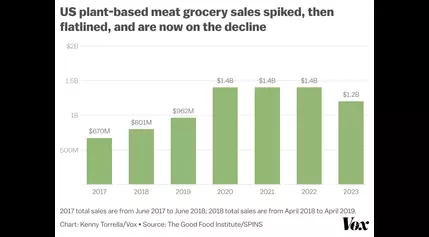
At the heart of the industry's struggles is the failure to win over consumers. Despite the hype, many people still don't find plant-based meat products to be a satisfactory replacement for conventional meat in terms of taste and texture. Premature media coverage, meat industry-funded attack ads, high price tags, and a flood of mediocre or poor-quality imitations have further compounded the challenge.The data reflects this disconnect, with grocery store plant-based meat sales in dollars slightly declining after a period of rapid growth, and the number of units sold falling by a staggering 26% over the last two years. While sales in restaurants and cafeterias, as well as in markets outside the US, have remained relatively flat or seen modest growth, the industry's core proposition – to provide a viable alternative to traditional meat – has yet to be fully realized.A Shifting Landscape and the Search for New Strategies
As the plant-based meat industry navigates this challenging environment, advocates are turning to new strategies to drive progress. Recognizing that progress doesn't always move in a straight line, they are exploring a range of policy levers and lobbying efforts to create a more level playing field and accelerate the development of alternative protein technologies.One key focus is on securing increased government funding for research and development (R&D) in the alternative protein sector, which has historically received a tiny fraction of the support enjoyed by the conventional meat and dairy industries. Advocates argue that targeted R&D investments could help improve the taste, texture, and affordability of plant-based and cell-cultivated meat products, making them more appealing to consumers.At the same time, plant-based advocates are working to expand the availability of plant-based options in schools and other federally-funded institutions, leveraging the power of public procurement to shift dietary norms and increase exposure to these alternatives. By chipping away at the dominance of meat and dairy in these settings, they hope to gradually reshape consumer preferences and build a more sustainable food system.Confronting Regulatory Hurdles and Industry Resistance
The plant-based meat industry also faces a range of regulatory and political challenges, as the conventional meat and dairy industries work to protect their market share. From labeling restrictions to outright bans on cell-cultivated meat, these industries and their legislative allies have deployed a playbook reminiscent of the fossil fuel industry's efforts to hamstring renewable energy.Advocates are pushing back against these discriminatory regulations, while also seeking to secure the same government support and low-interest loans that have historically benefited the conventional meat and dairy sectors. They argue that a level playing field is essential for alternative protein companies to scale up and compete effectively.The Path Forward: Navigating the Complexities of Dietary Transformation
The plant-based meat industry's journey has been a complex and often tumultuous one, marked by both promise and setbacks. As the sector navigates this shifting landscape, it must confront a range of challenges, from consumer skepticism to regulatory hurdles and industry resistance.However, the underlying imperative for a more sustainable food system remains, and advocates are exploring a range of strategies to drive progress. From securing increased R&D funding to expanding the availability of plant-based options in schools and other institutions, they are working to create the conditions for alternative proteins to thrive and ultimately transform the way we produce and consume food.The path forward is not a straight one, but with persistence, innovation, and a willingness to engage with the policy landscape, the plant-based meat industry may yet fulfill its promise of a meat-free revolution. The stakes are high, but the potential rewards – for the environment, animal welfare, and public health – are immense.
















































![FAO Food Price Index firm in June: higher vegetable oil, sugar and dairy prices offset lower cereal quotations [EN/AR/RU/ZH]](https://img.royaweb.io/news/1809a51f5f01952398c755bdb8b84e62.webp "FAO Food Price Index firm in June: higher vegetable oil, sugar and dairy prices offset lower cereal quotations [EN/AR/RU/ZH]")